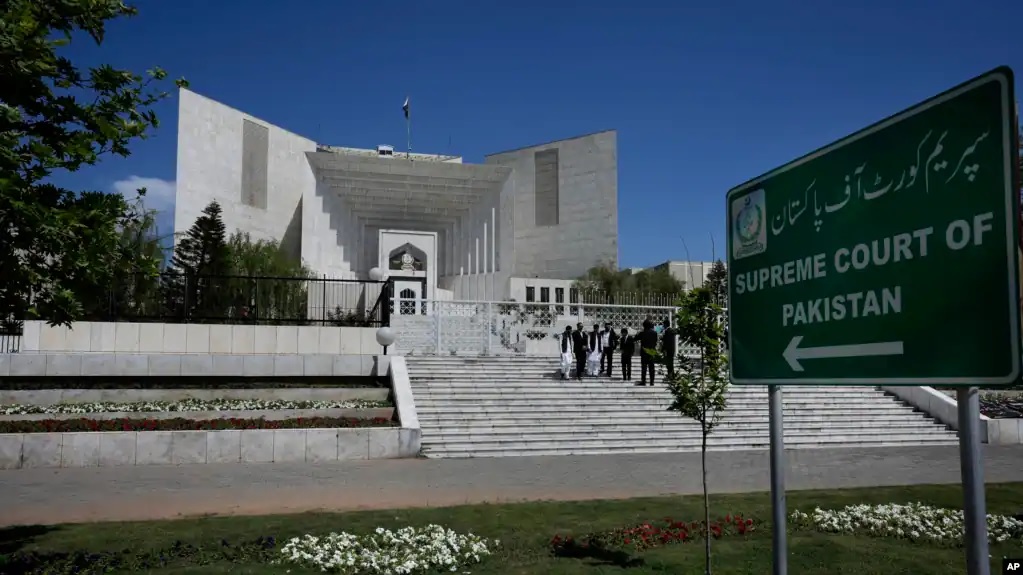

Pakistan Tehreek-e-Insaf (PTI) has urged the Chief Justice of Pakistan to immediately use his constitutional authority to restore the powers and status of the Supreme Court.
The party said Pakistan is currently standing on the brink of constitutional collapse, the rule of law is eroding, and the judiciary has faced a severe crisis of authority, credibility, and independence over the past decades.
In an open letter addressed to the Chief Justice, PTI stated that human rights violations are being carried out deliberately and systematically across the country.
The letter reads in part: “For this reason, we demand that the Supreme Court immediately restore its constitutional authority, enforce its rulings without exception, and hold defiant officials accountable. Judicial independence must be reinstated, and urgent relief must be provided to victims of political persecution, enforced disappearances, and suppression of dissent. Failure to act will only mean that justice in Pakistan is selective, subordinate, and inaccessible to the public.”
The letter further claims that former Prime Minister Imran Khan is clearly a victim of political persecution and is being kept in prison through fabricated cases. It also alleges that thousands of PTI members and supporters have been unlawfully arrested and imprisoned.
PTI sent the open letter at a time when, just last week, a court in Islamabad issued an arrest warrant for Khyber Pakhtunkhwa Chief Minister Sohail Afridi.
Afridi is accused of spreading “toxic propaganda” against Pakistan’s state institutions and of accusing the country’s army of shedding Pashtun blood.
Sohail Afridi, along with several other Pashtun politicians, opposes what Pakistan’s military establishment describes as counterterrorism operations currently underway in tribal areas.
Afridi said: “I was not a supporter of these operations yesterday, I am not a supporter today, and I will never support them in the future. These operations are being carried out through coercion and force. The decisions were made behind closed doors and imposed on us.”
Several other Pashtun nationalist leaders have also opposed the military operations, saying they are merely a pretext to suppress Pashtuns.
Manzoor Ahmad Pashteen, leader of the Pashtun Tahafuz Movement (PTM), said: “You saw in 2025 that more than 300 incidents occurred in which civilians, children, women, elderly people, and homes were targeted. Bombs were dropped on people while they were asleep or sitting in their homes. They call this a ‘targeted operation.’”
The debate over unconstitutional actions and unilateral policies by Pakistan’s current rulers has intensified as several political parties have described Islamabad’s policies toward Pashtuns and Baloch as problematic and have called for change.
According to these parties, Islamabad’s approach toward opposition groups—particularly Pashtuns and Baloch—is flawed, and failure to reform these policies could push the country into even deeper crises.