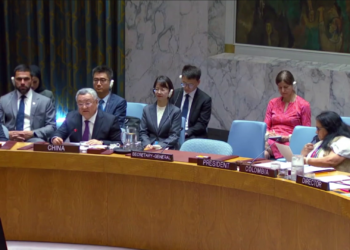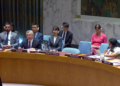


The United Nations Security Council is scheduled to meet today, Monday, to review the current political, security, and humanitarian situation in Afghanistan.
During the session, council members will discuss developments in Afghanistan over the past three months, focusing on political conditions, security issues, and humanitarian challenges.
According to the Security Council, the meeting will be held publicly, after which representatives of member states will hold closed consultations.
Although the Islamic Emirate has not commented on the meeting, analysts consider Security Council discussions on Afghanistan to be significant.
Political analyst Khalil Ahmad Nadim said: “Afghanistan’s relations with the international community are maintained through UNAMA, which reports to the United Nations every three months. Based on those reports, humanitarian assistance continues to reach Afghanistan.”
At the meeting, Georgette Gagnon, acting head of the United Nations Assistance Mission in Afghanistan, Adam Woogsorn from the United Nations Office for the Coordination of Humanitarian Affairs, and a representative of civil society are expected to brief participants on Afghanistan’s current situation.
The Islamic Emirate has repeatedly argued that previous Security Council assessments have not reflected realities on the ground in Afghanistan.
Political analyst Idris Mohammadi Zazi said: “The discussion should focus on understanding and cooperation, particularly on maintaining security. Forty million people are facing challenges because the government has not been internationally recognized. Solutions to these issues should be discussed so that Afghanistan can also take steps forward politically.”
Nearly one week after today’s session, the Security Council is expected to meet again to decide on extending UNAMA’s mandate in Afghanistan.
According to reports, the Council will vote on June 16 regarding the renewal of UNAMA’s mandate. While the Islamic Emirate has not publicly commented on the matter, observers view the mission as an important channel for political engagement between Afghanistan and the international community.
Former diplomat Aziz Maarij said: “Since the world has not formally recognized the Islamic Emirate, Afghanistan still needs UNAMA. It is the window through which Afghanistan maintains contact with the outside world and through which its challenges can be conveyed internationally.”
Political analyst Shahsawar Sangrowal added: “Because the Islamic Emirate does not have a diplomatic platform at the United Nations, UNAMA remains the only institution that can convey the voice of Afghans to the UN. It also regularly engages with humanitarian and charitable organizations regarding Afghanistan’s challenges.”
UNAMA was established on March 28, 2002, under Resolution 1401 of the United Nations Security Council.
The Security Council holds discussions on Afghanistan at least once every three months and conducts an annual review of UNAMA’s mandate.