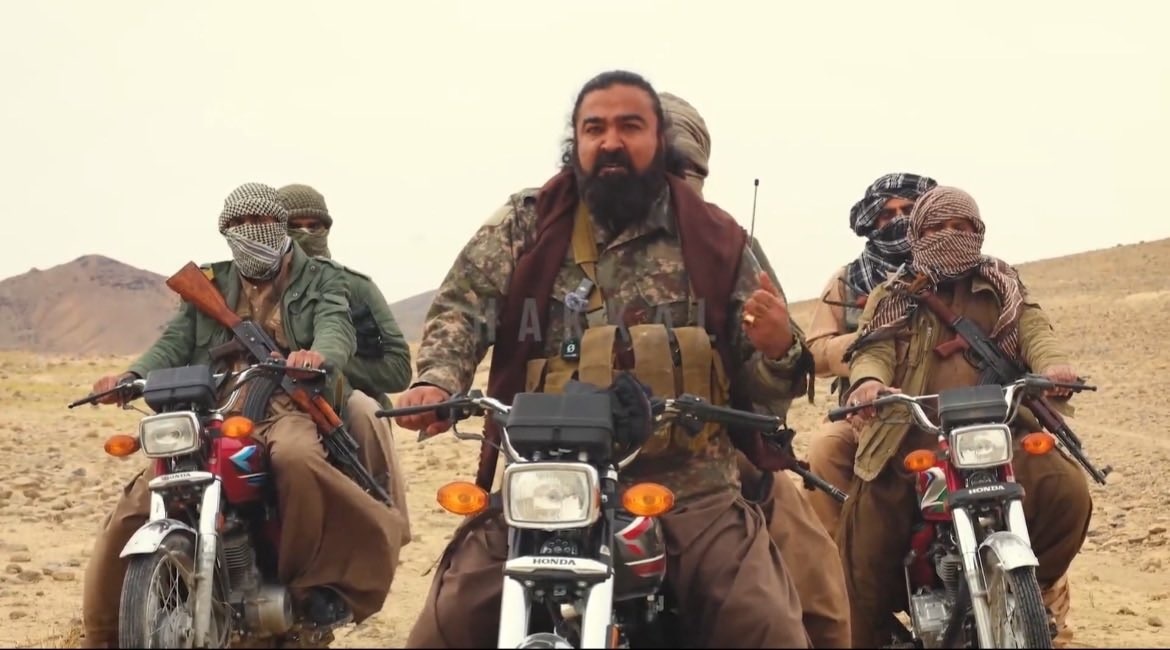
Baloch separatist groups have launched the second phase of large-scale military operations known as “Herof” against Pakistan’s military regime, beginning early Saturday morning.
As part of the Herof operation, attacks were carried out on Pakistani security force positions not only in Quetta, the capital of Balochistan, but also in Nushki, Mastung, Dalbandin, Kalat, Kharan, Gwadar, Pasni, Tump, and Bolida.
Videos circulating on social media show that the Baloch Liberation Army (BLA) used advanced weapons, drones, and ground assaults during the attacks. According to these reports, the group has taken full or partial control of Nushki, Mastung, Kharan, and several other areas.
So far, published reports have not clarified whether Pakistani forces have succeeded in retaking these areas from the Baloch separatists.
The number of casualties suffered by Pakistani forces in the attacks is reported to be in the dozens, though figures vary. Following the attacks, Pakistan declared a state of emergency in Balochistan. Authorities claimed that the attacks, allegedly carried out with India’s support, resulted in the deaths of 37 Baloch separatists and 10 Pakistani soldiers.
Balochistan Chief Minister Sarfraz Bugti said:
“Early this morning, terrorists carried out attacks in different parts of Pakistan in an attempt to boost their collapsing morale. However, these efforts were thwarted through joint operations by Balochistan Police and FC forces, and so far 37 militants have been killed.”
As a result of the attacks, nearly all public services in Quetta — including healthcare, education, transportation, and communication services — have been suspended.
In a video released by Baloch separatists, contradicting Pakistan’s claim that Baloch militant leaders are based in Afghanistan, the leader of the Baloch Liberation Army, Bashir Zeb Baloch, is seen directing the recent attacks from within Balochistan. He described the attacks as unprecedented and called on ordinary Baloch people to cooperate.
Bashir Zeb Baloch said:
“Today is the day of sacrifice. The expulsion of the Punjabi army and Punjabi state from Balochistan has begun. No enemy soldier or institution should remain in Balochistan. Baloch people, come out of your homes and stand alongside your brothers and sisters participating in the Herof-2 operation. History will record their defeat. Those who sacrifice themselves and achieve victory write history; the Baloch are the winners.”
The Baloch Liberation Army also reported that after seizing several government offices in Mastung, more than 30 prisoners were freed from a local prison.
Pakistan’s Prime Minister Shehbaz Sharif reacted to the attacks, stating that armed groups carried out assaults in 12 locations across Balochistan. Interior Minister Mohsin Naqvi also confirmed that 10 police officers were killed in the attacks.
Analysts describe the attacks as a result of Pakistan’s discriminatory policies, saying that both the population living along the Durand Line and the Baloch people are increasingly frustrated with Pakistan’s military rule.
Military analyst Akhtar Mohammad Rasekh said:
“Baloch separatists are advancing day by day. I believe the war imposed on the Baloch by Pakistani generals will ultimately end in the independence of Balochistan.”
The first phase of the Herof operation was launched by the Baloch Liberation Army in August 2024. According to the group’s claims, 130 Pakistani soldiers were killed during that phase, and BLA fighters managed to take control of major highways, several areas, and even government buildings for up to 20 hours.