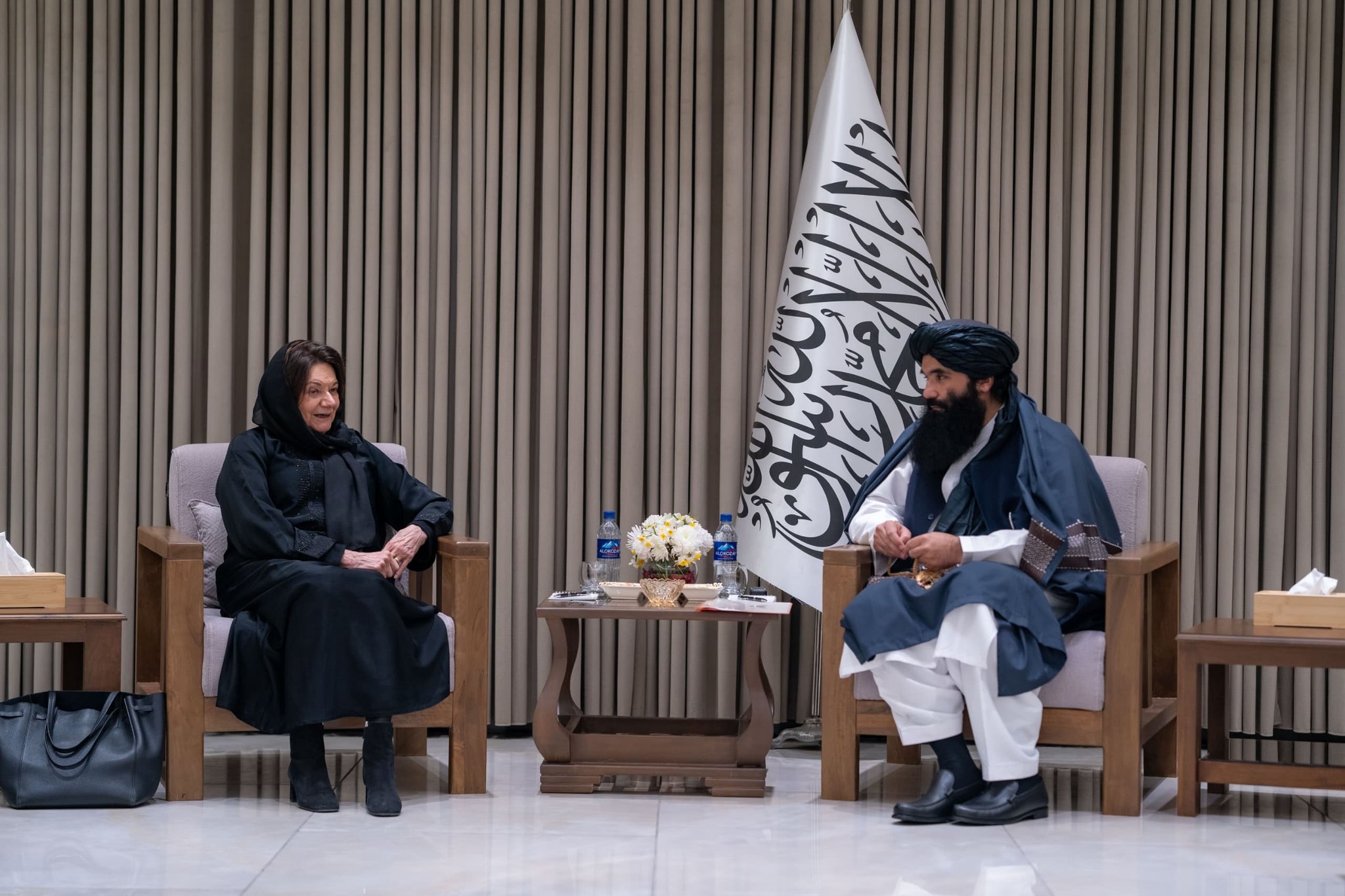
The Minister of Interior, in a meeting with a visiting delegation led by the United Nations Under-Secretary-General for Peace and Political Affairs, discussed political engagement between Afghanistan and the international community.
Officials from the Ministry of Interior said that during the meeting, Khalifa Sirajuddin Haqqani and Rosemary DiCarlo discussed progress in political engagement with Afghanistan, cooperation in combating narcotics, strengthening economic stability, ways to remove restrictions on the private sector, and the effectiveness of humanitarian assistance provided by the United Nations.
Ministry spokesperson Abdul Matin Qani said:
“In this meeting, discussions were held on advancing engagement between Afghanistan and the international community, cooperation in counter-narcotics efforts, strengthening economic stability, ways to remove existing restrictions on the private sector, and the effectiveness of UN humanitarian assistance.”
Political analysts say that such meetings should be used positively to advance political engagement between the Islamic Emirate and the international community. According to them, such talks are also very important for expanding relations.
Political analyst Moeen Gul Chamkani said:
“This in itself is a good opportunity for building relations. There were some points in the third Doha meeting that need practical steps for implementation. It is also believed—and was requested—that this time the Doha meeting be held in Kabul.”
In the meeting, the Minister of Interior said that serious and practical measures have been taken against the cultivation, production, and trafficking of narcotics, yielding positive results.
Earlier, the Foreign Minister also said during a meeting with the UN Under-Secretary-General that the government has seriously fought against the cultivation and trafficking of narcotics in Afghanistan.
Although he did not name any country, he expressed concern that if the cultivation of narcotics outside Afghanistan in the region is not prevented, not only Afghanistan but the region and the world could once again suffer as in the past.
Deputy Foreign Ministry spokesperson Zia Ahmad Takal said:
“The Foreign Minister referred to the Islamic Emirate’s serious measures against narcotics cultivation and trafficking in Afghanistan, and at the same time expressed concern that if narcotics cultivation outside Afghanistan in the region is not stopped, not only Afghanistan but the region and the world will once again suffer as before.”
Some other observers say that Pakistan is the only country in the region where narcotics cultivation and production are taking place.
Political analyst Ismail Zadran said:
“Narcotics have been completely banned in Afghanistan and there is no sign of them here, but in some neighboring countries—especially Pakistan—narcotics are cultivated and exported in the form of tablets. The international community and the United Nations should impose sanctions to stop this.”
Earlier reports had also stated that narcotics cultivation has increased in areas under Pakistan’s control and that, after harvest, attempts are made to smuggle these substances into Afghanistan.
However, the government assures that, in addition to these substances, the smuggling of all kinds of goods into the country has been prevented.