
The Afghanistan Breshna Sherkat (DABS) announced that the projects to generate 845 megawatts of electricity from solar and coal will be completed within the next three years at a cost of $462 million. These projects will be implemented in Kabul, as well as in Parwan, Baghlan, Takhar, and Ghazni provinces.
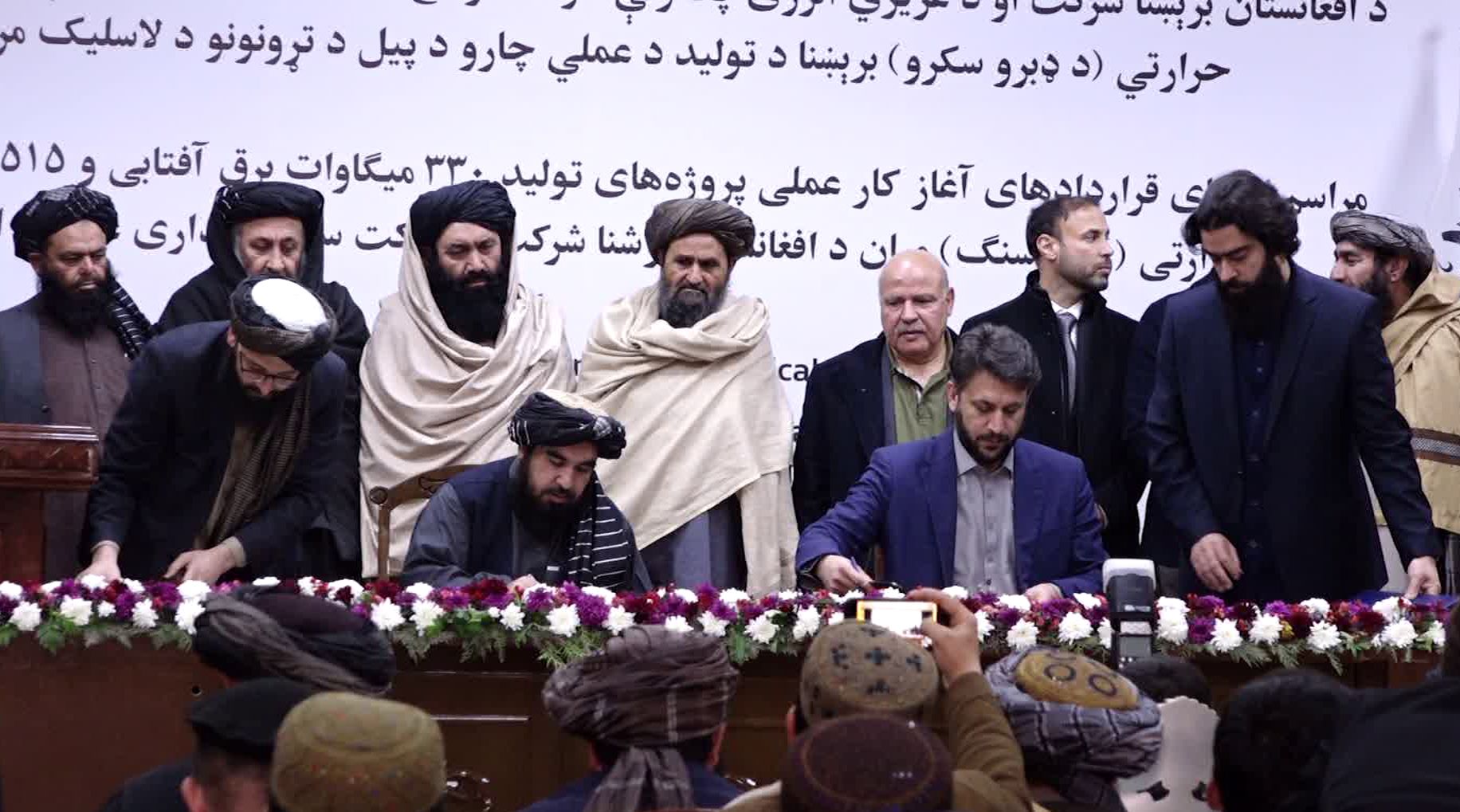
Agreements to start the implementation of these projects were signed between the Afghanistan Breshna Sherkat and Azizi Group in the presence of Deputy Chief of Staff for Economic Affairs, Mullah Abdul Ghani Baradar, and Azizi Group CEO, Merwais Azizi.
Officials from the Afghanistan Breshna Sherkat stated that the implementation of these projects will directly provide employment for around 1,000 people and indirectly create work opportunities for thousands more.
Mullah Abdul Haq Hamkar, CEO of the Afghanistan Breshna Sherkat, said: “The total capacity of these projects is 845 megawatts, which is nearly equal to the total electricity imported from neighboring countries. The total investment for these projects is estimated at around $463 million, approximately 30 billion Afghanis, and will be funded and invested by Azizi Energy Group.”
The Ministers of Water and Energy and of Mines and Petroleum assured full support and cooperation from all domestic and foreign investors, including Azizi Group. They emphasized that the country is a shared home for all, and the responsibility of development and prosperity lies with everyone.
They added that the government is working to provide a safe and suitable environment for investment so that national resources can be used to strengthen the country’s economy.
Officials also stated that construction work on the TAPI project in Herat is progressing well and is expected to be completed by the end of the current solar year.
Mullah Mohammad Younus Akhundzada, Minister of Water and Energy, said: “We are committed to supporting all investors working in any sector so that the country can become self-sufficient.”
Mullah Hedayatullah Badri, Minister of Mines and Petroleum, said: “On behalf of the Ministry of Mines, I assure Azizi Group and other investors that we are ready to provide coal in any quantity needed for electricity production.”
Meanwhile, Merwais Azizi, head of Azizi Group, stated that a new phase of Afghanistan’s economic and infrastructure development has begun following the Islamic Emirate’s return to power and the country’s full independence. He emphasized that independence is the fundamental condition for sustainable development.
He added that the key to solving many of the country’s challenges is self-sufficiency in electricity production. Azizi stressed that until Afghanistan generates its own electricity, industrial growth and economic stability will remain limited.
According to him, by the end of 2026, work will also begin to produce an additional 7,000 megawatts of electricity.
Merwais Azizi further said: “Within two or three months, we will hold another ceremony and sign agreements for another 2,000 to 3,000 megawatts of electricity. By the end of the year, we aim to reach agreements for five to six thousand megawatts. We have also discussed with the Minister of Mines that if some issues related to the TAPI project are resolved, we will immediately begin work on producing 3,000 megawatts in Herat.”
This comes after, in the month of August of the current solar year, Merwais Azizi signed agreements in Kabul for energy production projects worth $10 billion.
Currently, Afghanistan imports nearly 80% of its electricity needs from neighboring countries, particularly Uzbekistan, Tajikistan, Turkmenistan, and Iran.